
The 3D Asset Delivery Format
glTF™ is a royalty-free specification for the efficient transmission and loading of 3D scenes and models by engines and applications. glTF minimizes the size of 3D assets, and the runtime processing needed to unpack and use them. glTF defines an extensible publishing format that streamlines authoring workflows by enabling the interoperable use of 3D content across the industry.
THE 3D ASSET DELIVERY FORMAT
glTF: The JPEG of 3D
The core of glTF is a JSON file that describes the structure and composition of a scene containing 3D models, which can be stored in a single binary glTF file (.glb). The top-level elements of the file include: Scenes and nodes, cameras, meshes, buffers, materials, textures, skins and animations.
In 2022 glTF 2.0 was released as the ISO/IEC 12113:2022 International standard, recognizing glTF's global position as a 3D asset format.
Specifications Quick Reference Guide
gltf: Helping to Make 3D Pervasive
Features News and Events




The Open Industry Standard
glTF Specification, Extensions & Roadmap
The glTF 2.0 Specification
- The glTF 2.0 Specification in PDF and HTML format
- glTF as an ISO/IEC 12113:2022 specification
glTF Extensions
glTF extensions provide a convenient mechanism to innovate and extend any part of the core glTF format. Ratified KHR extensions are widely adopted and may be included in future versions of the glTF core specification. The community is also free to propose and create new glTF extensions.
- Ratified glTF 2.0 KHR extensions
- Vendor and Multi-Vendor extensions
- Adding new features to glTF
- Creating glTF Extensions.
The Official glTF Roadmap
- Track the status of extensions and projects that are in development for a general sense of the priorities and direction of the glTF roadmap. Khronos Extensions Roadmap
Essential Resources for Using glTF
Key Resources
Thanks to the support of the Khronos membership and our passionate developer community, there is a full set of well-supported developer tools and resources to help quickly get you up and running with your glTF application development.
- The glTF Quick Reference Guide
- glTF Sample Assets - a curated collection of glTF assets that illustrate one or more features or capabilities
- glTF Sample Viewer - The official Khronos glTF Sample Viewer and GitHub Repository
- glTF Validator – validates assets against the glTF 2.0 specification and extensions. GitHub Repo
- glTF Asset Auditor – use as part of your asset validation pipeline. View GitHub Repo and Blog Post
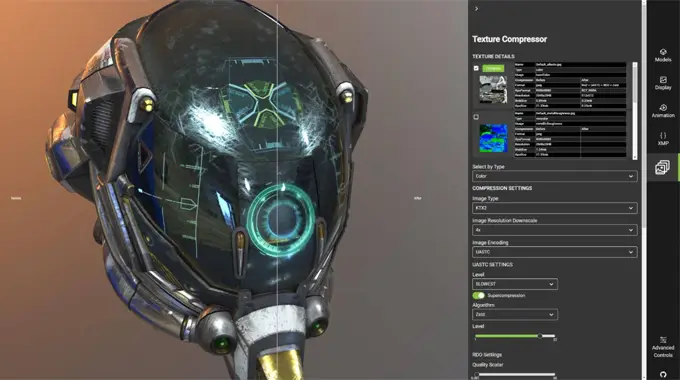
- glTF Texture Compressor / Optimizer - optimize assets using texture and geometry compression methods. View GitHub Repo and Blog Post
- glTF Real-Time Asset Creation Guidelines – streamline the creation of 3D assets for 3D commerce and more ... GitHub Repo
- glTF Viewer App for iOS - easily display glTF 3D models. View App Store, GitHub Repo and Blog Post
- glTF on YouTube (the official Khronos glTF playlist of tutorials, presentations)
- Past Khronos glTF Webinars and Events
- For a list of additional glTF Projects, Libraries and Utilities view the Khronos glTF Ecosystem Explorer
THE ROUTE TO REALISM
Khronos PBR (Physically Based Rendering)
Khronos glTF PBR defines a set of parameters that are used within glTF to simulate real-world lighting interactions, materials, and surface properties. The combination of glTF’s efficient delivery and PBR’s realism has become a game-changer for the 3D industry, empowering artists and developers to deliver compelling and visually captivating experiences. A wide range of physical properties are supported, with detailed descriptions available in the core glTF 2.0 specification and accompanying material Extensions.

glTF PBR Properties
The following glossary showcases some of the material effects that form part of the official Khronos PBR specification.
- Alpha Coverage
- Ambient Occlusion
- Base Color
- Emissive & Emissive Strength
- Metallic
- Normal
- Roughness
- Anisotropy
- Clearcoat
- Dispersion
- Index of Refraction
- Iridescence
- Sheen
- Specular
- Transmission
- Volume
- and more ...

The Portable GPU Friendly Texture Format
KTX 2.0 - Delivering GPU Compressed Textures in glTF
KTX (Khronos Texture) is an efficient, lightweight container format supported by glTF for reliably distributing GPU textures to a diverse range of platforms to reduce asset file size and GPU memory usage. KTX adds the ability to specify textures using KTX v2 images with Basis Universal supercompression and is available in viewers and applications supporting the KHR_texture_basisu extension. The contents of a KTX file can range from a simple base-level 2D texture to a cubemap array texture with mipmaps. A wide range of open-source tools are available to help artists and developers create, convert, validate and transcode KTX compressed textures.
Learn MoreRENDER EVERYTHING, EVERYWHERE
glTF and 3D Commerce
The Khronos 3D Commerce Working Group brings together industry-leading e-commerce companies to remove the barriers to deploying 3D commerce at scale using glTF. The group helps drive the development of the glTF format and ecosystem to meet the needs of 3D commerce including creating 3D authoring guidelines, tutorials and tools. Projects have included the development of the Material Variants extension and the glTF Asset Auditor and glTF Validator tools for streamlining and validating asset creation pipelines.
Learn More

TRUE-TO-LIFE 3D COLOR RENDERING
Khronos PBR Neutral Tone Mapper
The Khronos PBR Neutral Tone Mapper enables faithful reproduction of a product’s base color, hue and saturation when using PBR rendering under grayscale lighting, while eliminating HDR artifacts around highlights. It has been designed to display 3D assets rendered using PBR with true-to-life colors that are vital in eCommerce, architecture and CAD, and is enjoying wide adoption by 3D tools and engines
Learn MoreGet Involved
Help Shape the Future of glTF
The Khronos 3D Formats Working Group is constantly working to advance the use of glTF and is actively working on new initiatives (see Roadmap) to address any technical challenges, industry friction or new user requirements. Any organization is welcome to make contributions.
Community Discussions & Support
You'll find thriving glTF discussions on several platforms that provide a great way to get involved.
- glTF on Discord
- glTF on GitHub (see Issues and Pull Requests)
- glTF Khronos Discussion Forum
- glTF discussions on Stackoverflow
- glTF on LinkedIn
- glTF for 3D Commerce Working Group
Join the Khronos Group
If you are working with glTF and wish to get involved in helping shape its future, please consider joining Khronos and our Working Group. Any organization is welcome to join and multiple levels of membership are available to enable any organization, large or small, to get involved.
Join KhronosIndustry Support for glTF
The following organizations and projects have shown public support for glTF. If you would like to add you organization to this list please Contact Us describing you use of glTF.

Credits
- Credit 1: Copyright (c) 2021 Wayfair, LLC. CC BY 4.0 International. Sample model. Chair, Mixer and GeoPlanter ©Copyright 2020 Shopify Inc., licensed under CC-BY-4.0. Weber BBQ model courtesy of Epigraph and Ace Hardware, see blog post.
Khronos Standard Additional links and information
Related Discussions
Related News
Related Press
- glTF Interactivity Extension Submitted for Ratification
- Khronos Announces glTF Gaussian Splatting Extension
- The Khronos Group and VRM Consortium Collaborate to Advance International Standardization of the VRM 3D Avatar File Format
- Khronos PBR Neutral Tone Mapper Released for True-to-Life Color Rendering of 3D Products
- Khronos Releases Wave of New glTF PBR 3D Material Capabilities