# Telegram Messages Scraper (`curious_coder/telegram-scraper`) Actor
Scrape messages from any telegram group / channel / chats
- **URL**: https://apify.com/curious_coder/telegram-scraper.md
- **Developed by:** [Curious Coder](https://apify.com/curious_coder) (community)
- **Categories:** Social media, Automation
- **Features:** Limited permissions
- **Stats:** 7,174 total users, 30 monthly users, 100.0% runs succeeded, 117 bookmarks
- **User rating**: 2.01 out of 5 stars
## Pricing
Pay per usage
This Actor is paid per platform usage. The Actor is free to use, and you only pay for the Apify platform usage, which gets cheaper the higher subscription plan you have.
Learn more: https://docs.apify.com/actors/running/actors-in-store.md#pay-per-usage
## What's an Apify Actor?
An Actor is a serverless cloud program that runs on the Apify platform. It has two run modes.
In Batch mode, an Actor accepts a well-defined JSON input, performs an action which can take anything from a few seconds to a few hours,
and optionally produces a well-defined JSON output, datasets with results, or files in key-value store.
In Standby mode, an Actor provides a web server which can be used as a website, API, or an MCP server.
Apify vocabulary and the platform model are defined once, in the agent quickstart at https://apify.com/agents.md.
## How to integrate an Actor?
If asked about integration, you help developers integrate Actors into their projects.
You adapt to their stack and deliver integrations that are safe, well-documented, and production-ready.
Do not guess an integration path. Every one of them is in the agent quickstart at https://apify.com/agents.md: the Apify MCP server, Agent Skills with the Apify CLI, the JavaScript and Python clients, the REST API, and the account-free path for an agent with no human to sign in. It also carries the rule on stating cost before the first paid run.
For examples already wired to this Actor's own input schema, see the [API](#api) section below.
Each client library has reference documentation the quickstart does not restate: [JavaScript/TypeScript](https://docs.apify.com/api/client/js/docs.md) (`npm install apify-client`) and [Python](https://docs.apify.com/api/client/python/docs.md) (`pip install apify-client`).
# README
### Features
- Scrape messages from any telegram group or channel you have access to
https://youtu.be/j_vSazbotQ8
## Getting started
- Click on 'Try for free' button
- Go to 'Input' tab and select action you want to perform
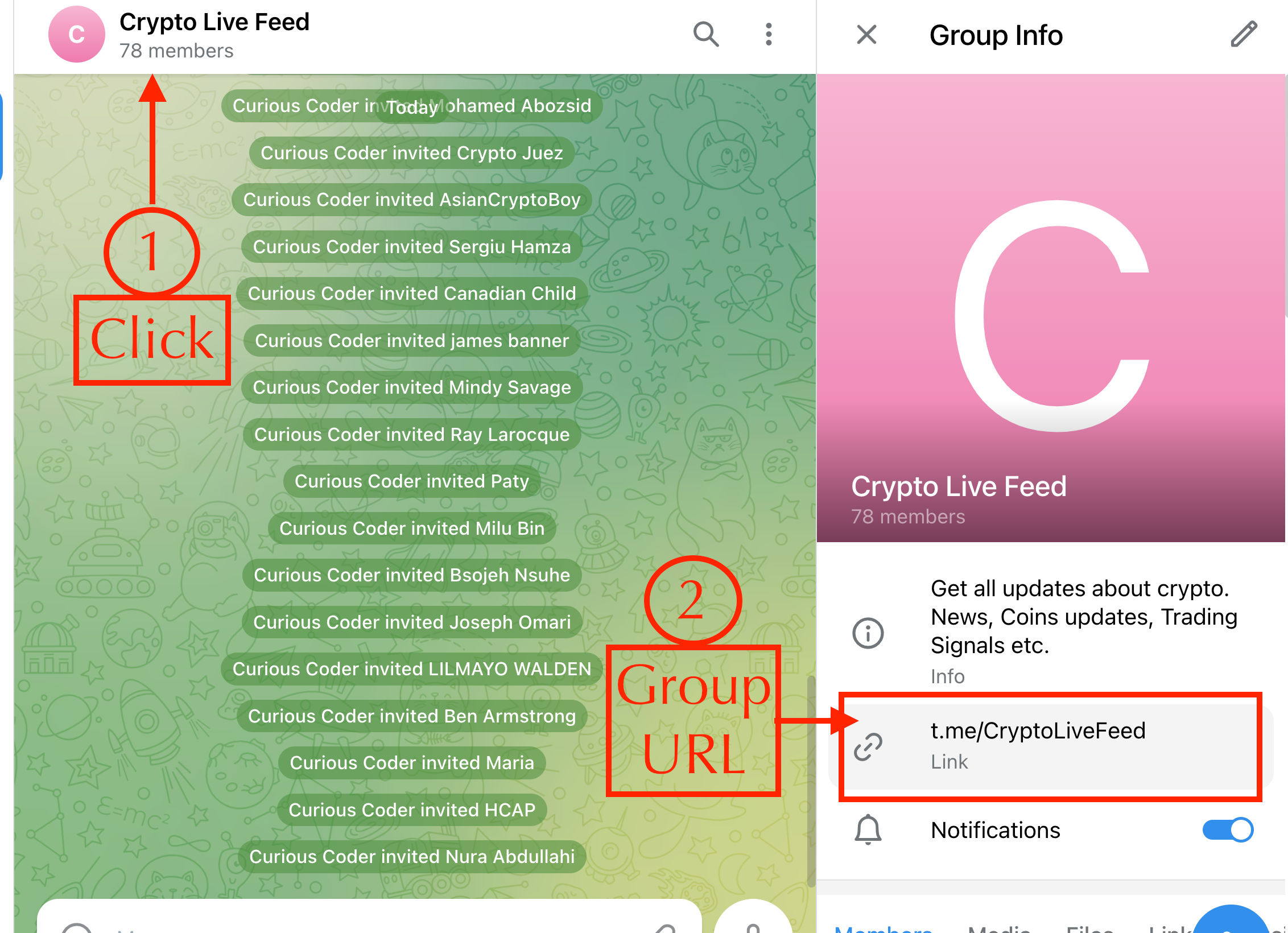
- Go to [web.telegram.org](https://web.telegram.org) and copy the group or channel URL you want to use.
- Paste it in the 'Group or channel to scrape messages' input field
- Click on 'Save and start' button
The following steps required only for first time:
- Go to 'Live view' tab to scan the QR code to authenticate the actor with telegram (This step is only one time)
- Open telegram app on your device.
- Go to Telegram menu -> Settings -> Devices and click on 'Add device' button and scan the QR code
- Copy the auth code to use it in future runs by filling 'Auth code'. If you pass auth token, you can avoid scanning QR code
✳️ **You might be interested in:** [Whatsapp scraper](https://apify.com/curious_coder/whatsapp-scraper) | [Discord scraper](https://apify.com/curious_coder/discord-data-scraper) | [Facebook group members scraper](https://apify.com/curious_coder/facebook-group-member-scraper) | [Other useful scrapers](https://apify.com/curious_coder)
### How to get group URL
### Integrations
You can use [Make](https://www.make.com/en/register?pc=growthhack) to integrate telegram scraper data to any other SaaS platform by designing your own automation flows.
### Message output
```json
{
"id": 12345,
"date": 1696420161,
"dateISO": "2023-10-04T12:29:21.000Z",
"text": "Hello from the group!",
"type": "Message",
"fromId": "202577853",
"fromUsername": "example_user",
"fromTitle": null,
"fromFirstName": "Pavel",
"fromLastName": "Tsyganov",
"replyToMsgId": null,
"views": 42,
"forwards": 3,
"mediaType": null,
"groupedId": null,
"editDate": null
}
```
# Changelog
This Actor's version history is a separate document: https://apify.com/curious_coder/telegram-scraper/changelog.md
# Actor input Schema
## `authToken` (type: `string`):
Used to authorize with telegram If not provied, you will be asked to scan a QR code to generate the token
## `scrapeGroup` (type: `string`):
Group or channel URL, @name or ID
To get the URL, go to [web.telegram.org](https://web.telegram.org) and open that group or channel, then copy the URL from the address bar.
Examples:
- `@group_name`
- `https://t.me/group_name`
- `1691104978`
- `https://web.telegram.org/k/#-1949445241`
## `startPage` (type: `integer`):
Page number to start scraping messages from (newest messages are on page 1)
## `count` (type: `integer`):
Maximum number of messages to scrape. Leave empty to scrape all available messages.
## `proxy.ip` (type: `string`):
No description
## `proxy.port` (type: `integer`):
No description
## `proxy.username` (type: `string`):
No description
## `proxy.password` (type: `string`):
No description
## Actor input object example
```json
{
"authToken": "",
"scrapeGroup": "https://t.me/BitSquad",
"startPage": 1,
"count": 10
}
```
# API
You can run this Actor programmatically using our API. Below are code examples in JavaScript, Python, and CLI, as well as the OpenAPI specification and MCP server setup.
## JavaScript example
```javascript
import { ApifyClient } from 'apify-client';
// Initialize the ApifyClient with your Apify API token
// Replace the '' with your token
const client = new ApifyClient({
token: '',
});
// Prepare Actor input
const input = {
"authToken": "",
"scrapeGroup": "https://t.me/BitSquad",
"startPage": 1,
"count": 10
};
// Run the Actor and wait for it to finish
const run = await client.actor("curious_coder/telegram-scraper").call(input);
// Fetch and print Actor results from the run's dataset (if any)
console.log('Results from dataset');
console.log(`💾 Check your data here: https://console.apify.com/storage/datasets/${run.defaultDatasetId}`);
const { items } = await client.dataset(run.defaultDatasetId).listItems();
items.forEach((item) => {
console.dir(item);
});
// 📚 Want to learn more 📖? Go to → https://docs.apify.com/api/client/js/docs
```
## Python example
```python
from apify_client import ApifyClient
# Initialize the ApifyClient with your Apify API token
# Replace '' with your token.
client = ApifyClient("")
# Prepare the Actor input
run_input = {
"authToken": "",
"scrapeGroup": "https://t.me/BitSquad",
"startPage": 1,
"count": 10,
}
# Run the Actor and wait for it to finish
run = client.actor("curious_coder/telegram-scraper").call(run_input=run_input)
# Fetch and print Actor results from the run's dataset (if there are any)
print(f"💾 Check your data here: https://console.apify.com/storage/datasets/{run.default_dataset_id}")
for item in client.dataset(run.default_dataset_id).iterate_items():
print(item)
# 📚 Want to learn more 📖? Go to → https://docs.apify.com/api/client/python/docs/quick-start
```
## CLI example
```bash
echo '{
"authToken": "",
"scrapeGroup": "https://t.me/BitSquad",
"startPage": 1,
"count": 10
}' |
apify call curious_coder/telegram-scraper --silent --output-dataset
```
## MCP server setup
```json
{
"mcpServers": {
"apify": {
"type": "http",
"url": "https://mcp.apify.com/?tools=fetch-actor-details,curious_coder/telegram-scraper"
}
}
}
```
The hosted server signs you in with OAuth on first connect, so no API token belongs in this config. Clients without OAuth support can send an `Authorization: Bearer ` header instead, using a token from API & Integrations in Apify Console (https://console.apify.com/settings/integrations).
## OpenAPI specification
Download the OpenAPI definition: https://api.apify.com/v2/actors/fFEdgN51AXsXPQpXl/builds/GyYP9WfVPGHtPDHSw/openapi.json